
Where can you find your Moon sign?
Create a birth chart with your birth date, local birth time and birth city. Find the Moon row in the planet table. The sign listed there is your Moon sign; the house number beside it is a separate detail. Your Sun sign and Moon sign don't have to match.
Can you find your Moon sign without a birth time?
If the Moon stays in one sign throughout your birth day, its sign can be established for that day. If it changes signs that day, the time matters. Starmora's form requires a birth time. If you enter an estimate, keep that uncertainty in mind, especially when reading the Moon's house.
Is a Moon sign the same as a Moon phase?
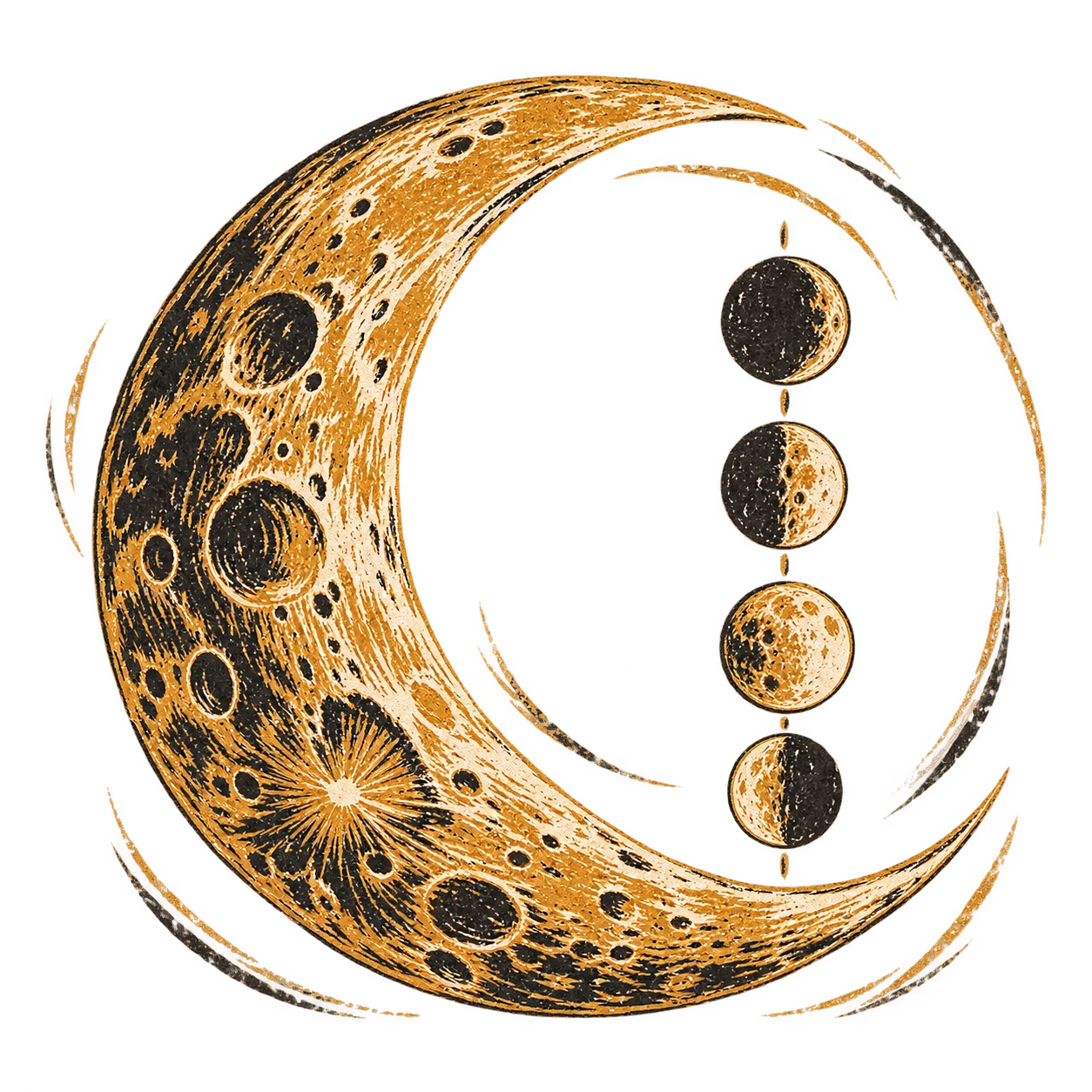
Your Moon sign tells you which zodiac sign the Moon occupied at your birth. Its phase, such as new moon, first quarter or full moon, describes how much of its lit side is visible. Two people with the same Moon sign can have been born under different Moon phases. Read these as separate details in your chart.
In the sky and in your chart
The Moon is Earth's natural satellite, and nothing in a chart moves faster: it stays in each sign for only about two and a half days. That is why your birth time matters for finding your Moon sign correctly. Your Moon sign and the Moon's phase on the day you were born (new moon, full moon and so on) are separate pieces of information. In astrology it rules Cancer.
What does it describe in your chart?
The Moon describes your feelings, your habits and what you need in order to feel safe. Whatever soothes you at the end of a tiring day is your Moon's voice. Everyone finds security in a different place: some people relax by talking, some in silence and some in an orderly space. Your Moon sign gives you a language for recognizing this need and putting a name to it.
Reading the sign, house and aspects together
When you read this planet in your chart, look at three things: its sign, its house and its aspects. The sign describes your emotional life. The house shows the area of life where this energy comes to the fore. The aspects describe how this planet connects with the others: which of your wishes support each other and which pull against each other. If your chart lists no aspects for this planet, it works more independently; that doesn't make it any less important.
An example placement
For example, if your Moon is in the 4th house, you feel most at ease at home and in your private life. If it is in the 11th house, your friends and the community you belong to give you a sense of security. If your Moon forms an aspect with Mercury, it is worth looking at how you put your feelings into words as well. Compare these placements with your own story; you know best which one feels familiar.
Try it in your own life
Compare two similar moments, one when you were rested and one when you were tired. Which part of your reaction repeats every time, and which part depends on that day's circumstances? Name the support that helps you, such as talking, having something to eat, being alone or knowing the plan. Once you say what you need, others don't have to guess it.
A short note on the calculations
The examples here were chosen to show how a reading works; the placements in your own chart may be different. A change in birth time or place affects the houses most. Starmora uses the Placidus house system by default; Whole Sign, Equal and Porphyry are also available. When you switch house systems, a planet's sign stays the same; only its house number may change. These interpretations are not predictions but a starting point for getting to know yourself better.
Sources and approach
These sources provide background on the traditional concepts or calculations on this page. Starmora’s original examples and reflection questions are not predictions drawn from these sources.